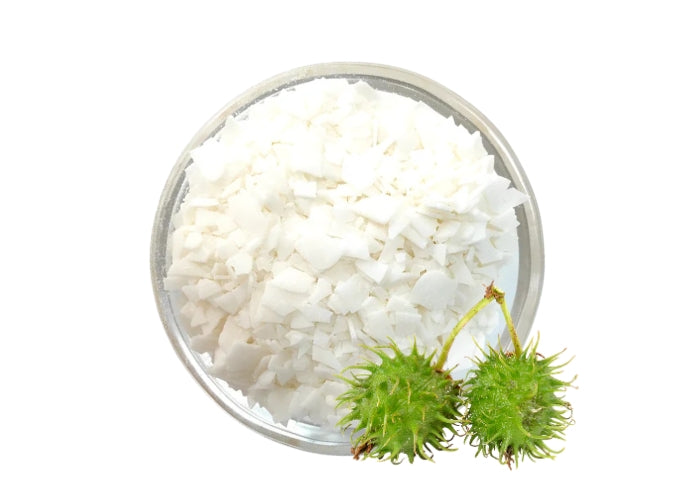
Castor Wax Flakes
Castor Wax Flakes
Castor Wax Flakes (Hydrogenated Castor Oil for Balms, Soap and Candles)
Castor Wax Flakes are hydrogenated castor oil: castor oil that has been hardened into a white, brittle wax with a high melting point of about 85-88 °C. Makers use it to thicken and firm balms, lip balms, sticks and creams, to stiffen soap, and to harden candle blends.
It is 100% hydrogenated castor oil with no added fragrance or dye, and we supply it from Kaiapoi, Christchurch, in 500 g, 1 kg and 2 kg packs. Every order is backed by a Specifications sheet, Safety Data Sheet, Ingredient Statement and Quick Guide, all linked in the Product Documents section below.
|
Hard castor oil wax Thickens and firms |
Melts at 85-88 °C Typical for this ingredient |
Use at 0.5-10% Start low, test first |
Balms, soap, candles Oil-soluble, not an emulsifier |
Safety information: for full hazard, handling and safety information, please see the Safety Data Sheet in the Product Documents section below.
Specifications
| Specification | Detail |
|---|---|
| Product | Castor Wax Flakes (Hydrogenated Castor Oil) |
| Type | Hard vegetable wax flakes to thicken, firm and stabilise balms, creams, soap and candle blends |
| Composition | Hydrogenated Castor Oil (INCI), 100%. Derived from castor (Ricinus communis) oil. CAS 8001-78-3. No added fragrance or dye |
| Appearance | White to off-white hard, brittle flakes. Little to no odour |
| Melting Point | Typically 85-88 °C (185-190 °F) |
| Typical Quality | Typical values for hydrogenated castor oil flakes, not for a particular batch: acid value 3 mg KOH/g or less, iodine value 3.5 or less, saponification value about 175-185, hydroxyl value 155 or more, Gardner colour 3 or less |
| Solubility | Insoluble in water. Dissolves into hot oils, butters and waxes when melted |
| Typical Use Rate | About 0.5-10% of the oil phase or wax blend. Start at the low end and work up. Always test |
| How to Add | Add the flakes to the hot oil or wax phase and heat to about 90 °C, stirring until fully melted and clear |
| Best Suited For | Lip balms, sticks and salves, lotion bars, creams (as a thickener), soap, polishes and candle blends |
| Not the Same As | PEG-40 Hydrogenated Castor Oil (a different ingredient) or liquid castor oil |
| Pack Sizes | 500 g, 1 kg, 2 kg |
| Storage | Cool, dry place, sealed, away from heat and sunlight |
| Shelf Life | Typically 2 years when stored sealed, cool and dry |
| Use | Raw material for makers. Safety assessment and labelling of finished products are the maker's responsibility. Not for food use |
How to Use Castor Wax Flakes
- Weigh. Weigh the oils, butters and waxes in your recipe, then weigh the flakes at about 0.5-10% of the oil phase. Start low and work up.
- Melt. Put the flakes in with the oils and waxes in a double boiler or other controlled heat. Heat to about 90 °C, stirring until every flake has melted and the mix is clear. Never heat over a direct flame or leave it unattended.
- Cool a little. Take off the heat. Add heat-sensitive ingredients such as fragrance, essential oils or vitamin E once the mix has cooled to a safe temperature for them.
- Pour. Pour into tubes, moulds, tins or jars. Stirring until the mix starts to thicken helps keep butters smooth.
- Set. Let the product set undisturbed. Cooling it fairly quickly, for example in a cool room or the fridge, helps avoid a grainy texture.
- Test. Check the firmness, glide and finish, then adjust the flake amount a little at a time in the next batch.
Tip: always make a small test batch first. Every recipe behaves a little differently.
What Is Castor Wax? ▼
Castor wax is hydrogenated castor oil. Liquid castor oil is pressed from castor beans, and hydrogenation turns it into a hard, brittle wax that melts at a much higher temperature. The main component is the triglyceride of 12-hydroxystearic acid.
That structure is why it is used as a thickener and stiffener. It dissolves into hot oils and butters and sets them firmer when they cool, raises the melting point of balms and sticks, and gives a smooth, slightly glossy finish.
Good to know: castor wax is not the same as PEG-40 Hydrogenated Castor Oil, which is a different, water-soluble ingredient used to solubilise oils. Castor wax does not dissolve in water and is not an emulsifier. It is also not the same as liquid castor bean oil.
Choosing the Right Thickener or Wax ▼
| Product | Best for | Notes |
|---|---|---|
| Castor Wax Flakes (this product) | Firming and thickening oil-based balms, sticks and creams; raising melt point | Hard and brittle with a high melt point. Used in small amounts. |
| Beeswax Refined Pellets | Balms, salves, lip balms, lotion bars | A softer, more pliable wax. Often used with castor wax. |
| Carnauba Wax | Hard, glossy sticks and polishes | A plant wax with a higher melt point than beeswax. |
| Emulsifying Wax (Neowax B200) | Creams and lotions that mix oil and water | An emulsifier. Castor wax thickens the oil phase but does not emulsify. |
| PEG-40 Hydrogenated Castor Oil | Dissolving oils and fragrance into water-based products | A solubiliser, not a thickening wax. A different ingredient. |
| Butters and waxes | Texture and richness | Browse our full range to build a balanced formula. |
Uses & Project Ideas ▼
Lip balms and balm sticks
Raises the melt point and firmness so sticks hold their shape. Pair it with beeswax and butters. Browse our lip balm bases and lip balm containers.
Salves and lotion bars
Blend with butters and oils for solid bars and balms that glide on. Use small amounts, as too much makes the bar hard and brittle.
Creams and lotions
Adds body to the oil phase as a thickener. Use it alongside an emulsifier such as Emulsifying Wax (Neowax B200).
Soap making
Some makers add a little to firm a bar. It is not a substitute for hardening oils, so test a small batch. Browse our soap additives.
Candle blends
Some candle makers add a small amount to soy and other waxes to firm the blend. This has not been tested by PureFX, so start very low (about 1%) and burn test before selling. See the Wick Guide below.
Polishes and coatings
Melted with oils and waxes for glossy, protective furniture and leather polishes.
Where to Start: Use Rates ▼
The usual range for castor wax is about 0.5-10% of the oil phase or wax blend. These are starting points, not fixed rules. Always make a small test batch and adjust a little at a time.
| Product | Where to start | Notes |
|---|---|---|
| Lip balms, balm sticks and salves | Toward the higher end of the range | Raises the melt point and firmness. Too much makes the product hard and brittle. |
| Lotion bars | Mid range | Blend with butters and beeswax so the bar still glides. |
| Creams and lotions | Toward the lower end of the range | Acts as a thickener only. You still need an emulsifier. |
| Soap | Test a small batch | Not a substitute for hardening oils. |
| Candles | About 1%, then test | Test burn before selling. See the Wick Guide below. |
Blending Ideas ▼
These are starting points only and have not been tested by PureFX, so test a small batch first.
| Blend with | Idea | Notes |
|---|---|---|
| Beeswax Refined Pellets | A small share of castor wax alongside beeswax | Beeswax gives flexibility and castor wax adds firmness. |
| Cocoa Butter Refined, Mango Butter or Kokum Butter | Butters for richness | Castor wax helps keep soft butters firm and reduces greasiness. |
| Carrier oils | The liquid base of a balm | Castor wax dissolves into the hot oil and thickens it as it cools. |
| Carnauba Wax | For harder, glossier sticks | Both are hard waxes, so use small amounts of each. |
Changing the ratios changes the melt point, firmness and feel, so always test a blend before selling products made with it.
Wick Guide for Candle Blends ▼
If you use castor wax in a candle blend, wick for the main wax and adjust. A firmer blend can burn slower, so you may need to go up a size. These are starting points only. Always burn test, then adjust one size at a time.
| Item | Where to start | Notes |
|---|---|---|
| ECO wicks | Choose by the width of the candle, as for your main wax | Go up a size if the flame is small or the candle tunnels, and down if the flame is large or sooty. |
| CDN wicks | Choose by the container width, as for your main wax | Test one size either side. |
| Wick trimmer | Before every burn | Trim to about 5 mm for a steady flame. |
Troubleshooting ▼
| Problem | Likely cause | What to try |
|---|---|---|
| Grainy or gritty texture | Flakes not fully melted, or the mix cooled slowly | Reheat to about 90 °C until clear, then cool a little faster. |
| Too hard or brittle | Too much castor wax | Reduce the amount, or add more soft oil or butter. |
| Too soft | Not enough castor wax or butter | Increase the amount a little at a time. |
| Waxy or draggy feel | Amount too high | Reduce the amount. |
| Cloudy or white bloom | Slow cooling or temperature swings | Reheat and cool faster, and store away from heat. |
| Flakes will not melt | Heat too low | Castor wax melts at about 85-88 °C. Heat the oil phase to about 90 °C and stir. |
Sizes & Price per kg
| Size | Price | Price per kg |
|---|---|---|
| 500 g | $14.50 | $29.00 |
| 1 kg | $27.00 | $27.00 |
| 2 kg | $49.00 | $24.50 |
Safety & Selling Your Products ▼
Molten wax can burn badly. Keep melting wax away from children and pets, never heat it over a direct flame, and never leave it unattended. Wear heat-resistant gloves, have a lid or damp cloth nearby for emergencies, and do not use water on a wax fire.
If you use it in candles, never leave a burning candle unattended, keep candles away from children, pets, draughts and anything flammable, and trim the wick to about 5 mm before each burn.
Selling your products? This is a raw material for makers. The safety assessment, labelling and any regulatory requirements for your finished soap, balm, cosmetic or candle are your responsibility. Use the Ingredient Statement and Safety Data Sheet below together with the safety data for everything else you add.
Frequently Asked Questions ▼
What is castor wax?
Hydrogenated castor oil: castor oil hardened into a white, brittle wax that melts at about 85-88 °C. It is used to thicken and firm balms, creams, soap and candle blends.
What is the melting point?
Typically 85-88 °C. Heat the oil phase to about 90 °C so every flake melts fully.
How much should I use?
Usually about 0.5-10% of the oil phase. Start low and work up, as too much makes products hard and brittle. Always test.
Is it the same as PEG-40 Hydrogenated Castor Oil?
No. This is plain hydrogenated castor oil, an oil-soluble wax. PEG-40 Hydrogenated Castor Oil is a different, water-soluble ingredient. We sell it separately.
Is it an emulsifier?
No. It thickens the oil phase but does not mix oil and water. For creams and lotions, use it with an emulsifier such as Emulsifying Wax (Neowax B200).
Does it dissolve in water?
No. It is insoluble in water and dissolves into hot oils, butters and waxes.
Can I use it in candles?
Some makers add a small amount to firm a candle blend. We have not tested this, so start very low (about 1%) and burn test before selling.
Can I use it in soap?
Some makers add a little to firm a bar. It is not a substitute for hardening oils, so test a small batch first.
Can I use it in lip balm?
Yes, it is commonly used to raise the melt point and firmness of lip balms and sticks. Use it with beeswax and butters, and start low.
Will it make my product grainy?
It can if the flakes are not fully melted or the mix cools slowly. Heat to about 90 °C until clear, then cool a little faster.
Is it vegan or natural?
It is made from castor oil, a plant source. We have not independently verified vegan, organic or other claims. Ask us before making one on your labels.
How should I store it?
Keep it sealed in a cool, dry place away from heat and sunlight. Typical shelf life is 2 years when stored this way.
Where is it made?
Ask us if you need origin information.
Pairs Well With
Pair castor wax with beeswax, cocoa butter, mango butter and kokum butter, and your choice of carrier oil. Fill lip balm containers, flavour with lip balm flavours, or build creams with Emulsifying Wax (Neowax B200). For candles, see our candle waxes and fragrance oils. Browse more butters and waxes and soap additives. |

Product Documents
|
Couldn't load pickup availability
Castor Wax Flakes (Hydrogenated Castor Oil for Balms, Soap and Candles)
Castor Wax Flakes are hydrogenated castor oil: castor oil that has been hardened into a white, brittle wax with a high melting point of about 85-88 °C. Makers use it to thicken and firm balms, lip balms, sticks and creams, to stiffen soap, and to harden candle blends.
It is 100% hydrogenated castor oil with no added fragrance or dye, and we supply it from Kaiapoi, Christchurch, in 500 g, 1 kg and 2 kg packs. Every order is backed by a Specifications sheet, Safety Data Sheet, Ingredient Statement and Quick Guide, all linked in the Product Documents section below.
|
Hard castor oil wax Thickens and firms |
Melts at 85-88 °C Typical for this ingredient |
Use at 0.5-10% Start low, test first |
Balms, soap, candles Oil-soluble, not an emulsifier |
Safety information: for full hazard, handling and safety information, please see the Safety Data Sheet in the Product Documents section below.
Specifications
| Specification | Detail |
|---|---|
| Product | Castor Wax Flakes (Hydrogenated Castor Oil) |
| Type | Hard vegetable wax flakes to thicken, firm and stabilise balms, creams, soap and candle blends |
| Composition | Hydrogenated Castor Oil (INCI), 100%. Derived from castor (Ricinus communis) oil. CAS 8001-78-3. No added fragrance or dye |
| Appearance | White to off-white hard, brittle flakes. Little to no odour |
| Melting Point | Typically 85-88 °C (185-190 °F) |
| Typical Quality | Typical values for hydrogenated castor oil flakes, not for a particular batch: acid value 3 mg KOH/g or less, iodine value 3.5 or less, saponification value about 175-185, hydroxyl value 155 or more, Gardner colour 3 or less |
| Solubility | Insoluble in water. Dissolves into hot oils, butters and waxes when melted |
| Typical Use Rate | About 0.5-10% of the oil phase or wax blend. Start at the low end and work up. Always test |
| How to Add | Add the flakes to the hot oil or wax phase and heat to about 90 °C, stirring until fully melted and clear |
| Best Suited For | Lip balms, sticks and salves, lotion bars, creams (as a thickener), soap, polishes and candle blends |
| Not the Same As | PEG-40 Hydrogenated Castor Oil (a different ingredient) or liquid castor oil |
| Pack Sizes | 500 g, 1 kg, 2 kg |
| Storage | Cool, dry place, sealed, away from heat and sunlight |
| Shelf Life | Typically 2 years when stored sealed, cool and dry |
| Use | Raw material for makers. Safety assessment and labelling of finished products are the maker's responsibility. Not for food use |
How to Use Castor Wax Flakes
- Weigh. Weigh the oils, butters and waxes in your recipe, then weigh the flakes at about 0.5-10% of the oil phase. Start low and work up.
- Melt. Put the flakes in with the oils and waxes in a double boiler or other controlled heat. Heat to about 90 °C, stirring until every flake has melted and the mix is clear. Never heat over a direct flame or leave it unattended.
- Cool a little. Take off the heat. Add heat-sensitive ingredients such as fragrance, essential oils or vitamin E once the mix has cooled to a safe temperature for them.
- Pour. Pour into tubes, moulds, tins or jars. Stirring until the mix starts to thicken helps keep butters smooth.
- Set. Let the product set undisturbed. Cooling it fairly quickly, for example in a cool room or the fridge, helps avoid a grainy texture.
- Test. Check the firmness, glide and finish, then adjust the flake amount a little at a time in the next batch.
Tip: always make a small test batch first. Every recipe behaves a little differently.
What Is Castor Wax? ▼
Castor wax is hydrogenated castor oil. Liquid castor oil is pressed from castor beans, and hydrogenation turns it into a hard, brittle wax that melts at a much higher temperature. The main component is the triglyceride of 12-hydroxystearic acid.
That structure is why it is used as a thickener and stiffener. It dissolves into hot oils and butters and sets them firmer when they cool, raises the melting point of balms and sticks, and gives a smooth, slightly glossy finish.
Good to know: castor wax is not the same as PEG-40 Hydrogenated Castor Oil, which is a different, water-soluble ingredient used to solubilise oils. Castor wax does not dissolve in water and is not an emulsifier. It is also not the same as liquid castor bean oil.
Choosing the Right Thickener or Wax ▼
| Product | Best for | Notes |
|---|---|---|
| Castor Wax Flakes (this product) | Firming and thickening oil-based balms, sticks and creams; raising melt point | Hard and brittle with a high melt point. Used in small amounts. |
| Beeswax Refined Pellets | Balms, salves, lip balms, lotion bars | A softer, more pliable wax. Often used with castor wax. |
| Carnauba Wax | Hard, glossy sticks and polishes | A plant wax with a higher melt point than beeswax. |
| Emulsifying Wax (Neowax B200) | Creams and lotions that mix oil and water | An emulsifier. Castor wax thickens the oil phase but does not emulsify. |
| PEG-40 Hydrogenated Castor Oil | Dissolving oils and fragrance into water-based products | A solubiliser, not a thickening wax. A different ingredient. |
| Butters and waxes | Texture and richness | Browse our full range to build a balanced formula. |
Uses & Project Ideas ▼
Lip balms and balm sticks
Raises the melt point and firmness so sticks hold their shape. Pair it with beeswax and butters. Browse our lip balm bases and lip balm containers.
Salves and lotion bars
Blend with butters and oils for solid bars and balms that glide on. Use small amounts, as too much makes the bar hard and brittle.
Creams and lotions
Adds body to the oil phase as a thickener. Use it alongside an emulsifier such as Emulsifying Wax (Neowax B200).
Soap making
Some makers add a little to firm a bar. It is not a substitute for hardening oils, so test a small batch. Browse our soap additives.
Candle blends
Some candle makers add a small amount to soy and other waxes to firm the blend. This has not been tested by PureFX, so start very low (about 1%) and burn test before selling. See the Wick Guide below.
Polishes and coatings
Melted with oils and waxes for glossy, protective furniture and leather polishes.
Where to Start: Use Rates ▼
The usual range for castor wax is about 0.5-10% of the oil phase or wax blend. These are starting points, not fixed rules. Always make a small test batch and adjust a little at a time.
| Product | Where to start | Notes |
|---|---|---|
| Lip balms, balm sticks and salves | Toward the higher end of the range | Raises the melt point and firmness. Too much makes the product hard and brittle. |
| Lotion bars | Mid range | Blend with butters and beeswax so the bar still glides. |
| Creams and lotions | Toward the lower end of the range | Acts as a thickener only. You still need an emulsifier. |
| Soap | Test a small batch | Not a substitute for hardening oils. |
| Candles | About 1%, then test | Test burn before selling. See the Wick Guide below. |
Blending Ideas ▼
These are starting points only and have not been tested by PureFX, so test a small batch first.
| Blend with | Idea | Notes |
|---|---|---|
| Beeswax Refined Pellets | A small share of castor wax alongside beeswax | Beeswax gives flexibility and castor wax adds firmness. |
| Cocoa Butter Refined, Mango Butter or Kokum Butter | Butters for richness | Castor wax helps keep soft butters firm and reduces greasiness. |
| Carrier oils | The liquid base of a balm | Castor wax dissolves into the hot oil and thickens it as it cools. |
| Carnauba Wax | For harder, glossier sticks | Both are hard waxes, so use small amounts of each. |
Changing the ratios changes the melt point, firmness and feel, so always test a blend before selling products made with it.
Wick Guide for Candle Blends ▼
If you use castor wax in a candle blend, wick for the main wax and adjust. A firmer blend can burn slower, so you may need to go up a size. These are starting points only. Always burn test, then adjust one size at a time.
| Item | Where to start | Notes |
|---|---|---|
| ECO wicks | Choose by the width of the candle, as for your main wax | Go up a size if the flame is small or the candle tunnels, and down if the flame is large or sooty. |
| CDN wicks | Choose by the container width, as for your main wax | Test one size either side. |
| Wick trimmer | Before every burn | Trim to about 5 mm for a steady flame. |
Troubleshooting ▼
| Problem | Likely cause | What to try |
|---|---|---|
| Grainy or gritty texture | Flakes not fully melted, or the mix cooled slowly | Reheat to about 90 °C until clear, then cool a little faster. |
| Too hard or brittle | Too much castor wax | Reduce the amount, or add more soft oil or butter. |
| Too soft | Not enough castor wax or butter | Increase the amount a little at a time. |
| Waxy or draggy feel | Amount too high | Reduce the amount. |
| Cloudy or white bloom | Slow cooling or temperature swings | Reheat and cool faster, and store away from heat. |
| Flakes will not melt | Heat too low | Castor wax melts at about 85-88 °C. Heat the oil phase to about 90 °C and stir. |
Sizes & Price per kg
| Size | Price | Price per kg |
|---|---|---|
| 500 g | $14.50 | $29.00 |
| 1 kg | $27.00 | $27.00 |
| 2 kg | $49.00 | $24.50 |
Safety & Selling Your Products ▼
Molten wax can burn badly. Keep melting wax away from children and pets, never heat it over a direct flame, and never leave it unattended. Wear heat-resistant gloves, have a lid or damp cloth nearby for emergencies, and do not use water on a wax fire.
If you use it in candles, never leave a burning candle unattended, keep candles away from children, pets, draughts and anything flammable, and trim the wick to about 5 mm before each burn.
Selling your products? This is a raw material for makers. The safety assessment, labelling and any regulatory requirements for your finished soap, balm, cosmetic or candle are your responsibility. Use the Ingredient Statement and Safety Data Sheet below together with the safety data for everything else you add.
Frequently Asked Questions ▼
What is castor wax?
Hydrogenated castor oil: castor oil hardened into a white, brittle wax that melts at about 85-88 °C. It is used to thicken and firm balms, creams, soap and candle blends.
What is the melting point?
Typically 85-88 °C. Heat the oil phase to about 90 °C so every flake melts fully.
How much should I use?
Usually about 0.5-10% of the oil phase. Start low and work up, as too much makes products hard and brittle. Always test.
Is it the same as PEG-40 Hydrogenated Castor Oil?
No. This is plain hydrogenated castor oil, an oil-soluble wax. PEG-40 Hydrogenated Castor Oil is a different, water-soluble ingredient. We sell it separately.
Is it an emulsifier?
No. It thickens the oil phase but does not mix oil and water. For creams and lotions, use it with an emulsifier such as Emulsifying Wax (Neowax B200).
Does it dissolve in water?
No. It is insoluble in water and dissolves into hot oils, butters and waxes.
Can I use it in candles?
Some makers add a small amount to firm a candle blend. We have not tested this, so start very low (about 1%) and burn test before selling.
Can I use it in soap?
Some makers add a little to firm a bar. It is not a substitute for hardening oils, so test a small batch first.
Can I use it in lip balm?
Yes, it is commonly used to raise the melt point and firmness of lip balms and sticks. Use it with beeswax and butters, and start low.
Will it make my product grainy?
It can if the flakes are not fully melted or the mix cools slowly. Heat to about 90 °C until clear, then cool a little faster.
Is it vegan or natural?
It is made from castor oil, a plant source. We have not independently verified vegan, organic or other claims. Ask us before making one on your labels.
How should I store it?
Keep it sealed in a cool, dry place away from heat and sunlight. Typical shelf life is 2 years when stored this way.
Where is it made?
Ask us if you need origin information.
Pairs Well With
Pair castor wax with beeswax, cocoa butter, mango butter and kokum butter, and your choice of carrier oil. Fill lip balm containers, flavour with lip balm flavours, or build creams with Emulsifying Wax (Neowax B200). For candles, see our candle waxes and fragrance oils. Browse more butters and waxes and soap additives. |
|
Product Documents
|