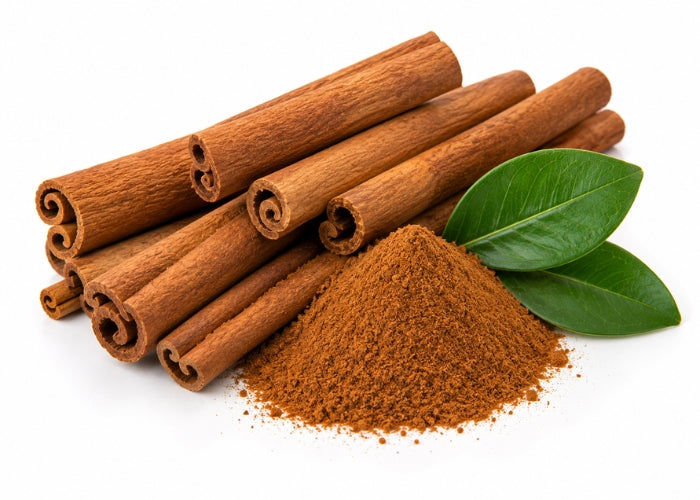
Cinnamon Essential Oil
Cinnamon Essential Oil
Cinnamon Leaf Essential Oil (Cinnamomum verum)
Cinnamon Leaf (Cinnamomum verum, also known botanically as Cinnamomum zeylanicum) is steam-distilled from the leaves, yielding a pale amber to reddish-brown liquid with a warm, spicy, woody, resinous aroma. Its high eugenol content (70–85%) gives it a much sharper, more restricted safety profile than milder aromatic oils.
Diffused, Cinnamon Leaf's warm, spicy aroma is traditionally used to lift mood during low, tired or stressful times and to support a sense of physical and emotional vitality. In a well-diluted massage blend, it has long been reached for to warm tight muscles and joints, ease rheumatic and arthritic discomfort, and support the respiratory system during colds and bronchitis, as well as to calm occasional digestive spasms.
Traditionally, Cinnamon Leaf has also been regarded as an emmenagogue (an oil that can encourage menstruation), so it is generally avoided during pregnancy.
This one deserves a little extra care: Cinnamon Leaf is one of the more potent oils in our range, thanks to its naturally high eugenol content, so it's best kept to aromatic use rather than skincare or leave-on preparations. If including it in a massage blend, keep dilution very low, patch test first, and avoid the eyes, mucous membranes and the face. It's best avoided during pregnancy, breastfeeding, on children, and always keep it well out of reach of little hands.
Specifications
| Specification | Detail |
|---|---|
| Botanical Name | Cinnamomum verum (syn. Cinnamomum zeylanicum) |
| Plant Part Used | Leaves |
| Extraction Method | Steam Distilled |
| Origin | Sri Lanka |
| Purity | 100% Pure and Natural |
| Appearance | Pale Amber to Reddish-Brown Liquid |
| Specific Gravity | 1.030 to 1.066 @ 20°C |
| Refractive Index | 1.525 to 1.540 @ 20°C |
| Shelf Life | 2 Years (Properly Stored) |
Uses ▼
Burners and vaporizers
Diffused, Cinnamon Leaf's warm, spicy aroma is traditionally used to lift mood during low or tired times, and to support the respiratory system during colds, bronchitis and sneezing.
Blended massage oil or in the bath
Used in a very well-diluted massage blend, Cinnamon Leaf is traditionally reached for to warm tight muscles and joints, ease rheumatic and arthritic discomfort, support the respiratory system during bronchitis and flu, and calm occasional digestive spasms and nausea. Always dilute thoroughly and avoid contact with the eyes and mucous membranes.
Blended in base cream
Because Cinnamon Leaf is one of the more potent oils in our range, it's not recommended for use in home-blended creams, lotions or other leave-on skincare preparations.
Blends Well With
| Although essential oils blend well with one another, Cinnamon Leaf oil goes particularly well with other essential oils such as frankincense, lavender, cedarwood, ylang ylang and various citrus oils. |
Usage & Formulation Guide ▼
For soap makers, natural perfumers and cosmetic formulators. These are starting points, not finished formulas — always confirm compliance, stability and safety (including IFRA usage limits) for your own finished product before use.
Fine Fragrance & Perfumery
Cinnamon Leaf's warm, spicy-woody character makes it a useful supporting note in oriental, spice and gourmand accords, but eugenol carries firm IFRA limits. IFRA restricts eugenol to a maximum of 2.5% in Category 4 (fine fragrance). Given this oil's 70–85% eugenol content, that caps the whole oil at roughly 3% of a fragrance concentrate at the very most — in practice most perfumers use it far below this, often under 1% of the total formula, as an accent alongside clove bud, cassia, benzoin or warm woods rather than a dominant note.
Cold-Process Soap
IFRA Category 9 (soap and other wash-off products) sets a eugenol limit of 4.9% in the finished bar, which at this oil's 70–85% eugenol content works out to a ceiling of roughly 5.8–7% of total oil weight as Cinnamon Leaf. Treat this as a mathematical ceiling, not a target: eugenol is a well-documented skin sensitiser that survives saponification and curing to a meaningful degree, so sensitisation reactions have been reported even in fully cured cinnamon-scented soap. Most formulators keep Cinnamon Leaf to a minor fraction of a blended fragrance (rather than the whole scent) and dose well under the IFRA ceiling. Always verify against your specific batch's actual eugenol content (check the CoA) rather than relying on typical ranges.
Diffuser Blends & Room Fragrance
Outside of skin-contact applications, Cinnamon Leaf works well in reed diffusers, wax melts and burner blends, pairing nicely with citrus, clove, cedarwood and vanilla-type notes for warm, cold-weather blends. Because eugenol vapour can still irritate the eyes, nose and airways at higher concentrations, keep the total load modest in any blend and ensure the space is well ventilated.

Product Documents SPECIFICATIONSSAFETY DATA SHEETIFRA GUIDELINESUSER GUIDE |
Couldn't load pickup availability
Cinnamon Leaf Essential Oil (Cinnamomum verum)
Cinnamon Leaf (Cinnamomum verum, also known botanically as Cinnamomum zeylanicum) is steam-distilled from the leaves, yielding a pale amber to reddish-brown liquid with a warm, spicy, woody, resinous aroma. Its high eugenol content (70–85%) gives it a much sharper, more restricted safety profile than milder aromatic oils.
Diffused, Cinnamon Leaf's warm, spicy aroma is traditionally used to lift mood during low, tired or stressful times and to support a sense of physical and emotional vitality. In a well-diluted massage blend, it has long been reached for to warm tight muscles and joints, ease rheumatic and arthritic discomfort, and support the respiratory system during colds and bronchitis, as well as to calm occasional digestive spasms.
Traditionally, Cinnamon Leaf has also been regarded as an emmenagogue (an oil that can encourage menstruation), so it is generally avoided during pregnancy.
This one deserves a little extra care: Cinnamon Leaf is one of the more potent oils in our range, thanks to its naturally high eugenol content, so it's best kept to aromatic use rather than skincare or leave-on preparations. If including it in a massage blend, keep dilution very low, patch test first, and avoid the eyes, mucous membranes and the face. It's best avoided during pregnancy, breastfeeding, on children, and always keep it well out of reach of little hands.
Specifications
| Specification | Detail |
|---|---|
| Botanical Name | Cinnamomum verum (syn. Cinnamomum zeylanicum) |
| Plant Part Used | Leaves |
| Extraction Method | Steam Distilled |
| Origin | Sri Lanka |
| Purity | 100% Pure and Natural |
| Appearance | Pale Amber to Reddish-Brown Liquid |
| Specific Gravity | 1.030 to 1.066 @ 20°C |
| Refractive Index | 1.525 to 1.540 @ 20°C |
| Shelf Life | 2 Years (Properly Stored) |
Uses ▼
Burners and vaporizers
Diffused, Cinnamon Leaf's warm, spicy aroma is traditionally used to lift mood during low or tired times, and to support the respiratory system during colds, bronchitis and sneezing.
Blended massage oil or in the bath
Used in a very well-diluted massage blend, Cinnamon Leaf is traditionally reached for to warm tight muscles and joints, ease rheumatic and arthritic discomfort, support the respiratory system during bronchitis and flu, and calm occasional digestive spasms and nausea. Always dilute thoroughly and avoid contact with the eyes and mucous membranes.
Blended in base cream
Because Cinnamon Leaf is one of the more potent oils in our range, it's not recommended for use in home-blended creams, lotions or other leave-on skincare preparations.
Blends Well With
| Although essential oils blend well with one another, Cinnamon Leaf oil goes particularly well with other essential oils such as frankincense, lavender, cedarwood, ylang ylang and various citrus oils. |
Usage & Formulation Guide ▼
For soap makers, natural perfumers and cosmetic formulators. These are starting points, not finished formulas — always confirm compliance, stability and safety (including IFRA usage limits) for your own finished product before use.
Fine Fragrance & Perfumery
Cinnamon Leaf's warm, spicy-woody character makes it a useful supporting note in oriental, spice and gourmand accords, but eugenol carries firm IFRA limits. IFRA restricts eugenol to a maximum of 2.5% in Category 4 (fine fragrance). Given this oil's 70–85% eugenol content, that caps the whole oil at roughly 3% of a fragrance concentrate at the very most — in practice most perfumers use it far below this, often under 1% of the total formula, as an accent alongside clove bud, cassia, benzoin or warm woods rather than a dominant note.
Cold-Process Soap
IFRA Category 9 (soap and other wash-off products) sets a eugenol limit of 4.9% in the finished bar, which at this oil's 70–85% eugenol content works out to a ceiling of roughly 5.8–7% of total oil weight as Cinnamon Leaf. Treat this as a mathematical ceiling, not a target: eugenol is a well-documented skin sensitiser that survives saponification and curing to a meaningful degree, so sensitisation reactions have been reported even in fully cured cinnamon-scented soap. Most formulators keep Cinnamon Leaf to a minor fraction of a blended fragrance (rather than the whole scent) and dose well under the IFRA ceiling. Always verify against your specific batch's actual eugenol content (check the CoA) rather than relying on typical ranges.
Diffuser Blends & Room Fragrance
Outside of skin-contact applications, Cinnamon Leaf works well in reed diffusers, wax melts and burner blends, pairing nicely with citrus, clove, cedarwood and vanilla-type notes for warm, cold-weather blends. Because eugenol vapour can still irritate the eyes, nose and airways at higher concentrations, keep the total load modest in any blend and ensure the space is well ventilated.
|
Product Documents SPECIFICATIONSSAFETY DATA SHEETIFRA GUIDELINESUSER GUIDE |