Cedarwood Essential Oil
Cedarwood Essential Oil
Cedarwood Essential Oil (Cedrus deodara)
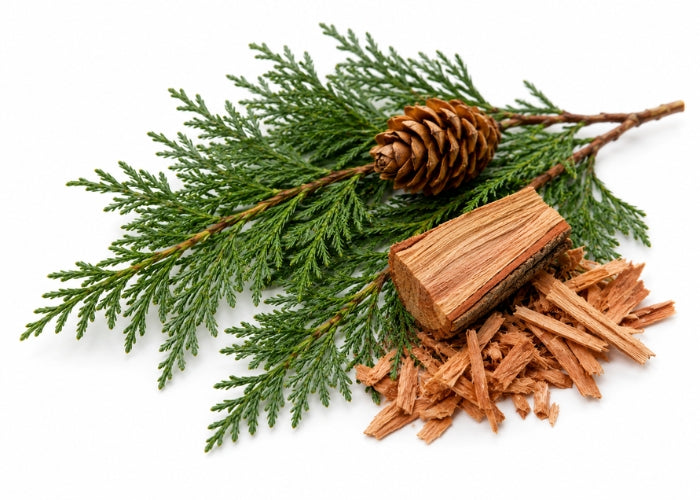
Cedarwood (Cedrus deodara) is steam-distilled from the roots and stumps left behind after timber harvesting in the Himalayan region, producing a warm, woody, balsamic aroma with a slightly camphoraceous edge. Prized in perfumery as a fixative, it also anchors floral and woody blends beautifully.
Traditionally valued for its astringent action, Cedarwood is used to help balance acne-prone and oily skin, and as a scalp tonic to support hair health and ease dandruff. In vapour therapy and diluted massage blends, it has long been used as a general tonic and to support the respiratory system, while also easing the discomfort of stiff, painful joints.
Emotionally, Cedarwood has a calming, grounding effect that soothes anxiety and nervous tension, making it a popular choice for meditation and quiet reflection.
A little care goes a long way: Cedarwood isn't meant to be swallowed, so keep it well away from little hands and mouths. Always dilute before applying to the skin and do a patch test first, avoid contact with mucous membranes, and take extra care during pregnancy or breastfeeding, with children under 6, or if you have epilepsy.
Specifications
| Specification | Detail |
|---|---|
| Botanical Name | Cedrus deodara |
| Plant Part Used | Roots and Stumps (Post-Timber Extraction) |
| Extraction Method | Steam Distillation |
| Origin | Kannauj, India |
| Purity | 100% Pure, Natural, Undiluted |
| Appearance | Clear, Pale Yellow to Amber Liquid |
| Specific Gravity | 0.940 to 0.960 @ 25°C |
| Refractive Index | 1.510 to 1.520 @ 20°C |
| Shelf Life | 3–4 Years (Properly Stored) |
Uses ▼
Burners and vaporizers
In vapour therapy, Cedarwood can be used as a general tonic and to support the respiratory system during bronchitis and colds, while its calming, grounding aroma helps ease anxiety and nervous tension and supports meditation.
Blended massage oil or in the bath
Well diluted in a massage oil or in the bath, Cedarwood can help ease stiff, painful joints associated with arthritis and rheumatism, and support the respiratory system during bronchitis and catarrh. Take care to avoid contact with mucous membranes.
Blended in base cream
Cedarwood's astringent action makes it a useful addition to a blended cream or scalp treatment for acne-prone and oily skin, and as a tonic for oily hair and dandruff.
Blends Well With
| Although essential oils blend well with one another, Cedarwood oil goes particularly well with other essential oils such as bergamot, clary sage, cypress, frankincense, geranium, grapefruit, jasmine, juniper, lavender, rosemary, sandalwood and vetiver. |
Usage & Formulation Guide ▼
For soap makers, natural perfumers and cosmetic formulators. These are starting points, not finished formulas — always confirm compliance, stability and safety (including IFRA usage limits) for your own finished product before use.
Perfumery & Fine Fragrance
A classic dry, woody base note that anchors and extends a composition. It pairs naturally with sandalwood, vetiver and patchouli for depth, with bergamot, black pepper and other citrus top notes for a fresh, masculine-leaning woody accord, and with florals such as jasmine or rose where a soft woody backbone is wanted. A simple starting accord is roughly 2 parts Cedarwood to 1 part Bergamot with a touch of Black Pepper.
Leave-On Skincare & Hair Care
Commonly included at around 2–3% in scalp and hair-care oils and in blends for oily or acne-prone skin, where its astringent, toning character is valued — for example, 3% Cedarwood with 2% Rosemary in a Jojoba oil base for a scalp treatment blend. Cedarwood is generally regarded as a well-tolerated, low-restriction material under IFRA guidelines, but as with any leave-on formulation, patch-test the finished product and check current IFRA limits for your specific product category before finalising a recipe.
Aromatherapy & Diffuser Blends
Suits grounding, calming diffuser combinations — try 3 drops Cedarwood with 2 drops Frankincense and 1 drop Vetiver for a deep, meditative base blend.
Cold Process Soap Making
One of the most popular natural fragrance choices for handmade soap, typically used at around 2–3% of total oil weight. Being a heavier, resinous oil it can accelerate trace, so adjust your recipe and work speed accordingly.

Product Documents SPECIFICATIONSSAFETY DATA SHEETIFRA GUIDELINESUSER GUIDE |
Couldn't load pickup availability
Cedarwood Essential Oil (Cedrus deodara)
Cedarwood (Cedrus deodara) is steam-distilled from the roots and stumps left behind after timber harvesting in the Himalayan region, producing a warm, woody, balsamic aroma with a slightly camphoraceous edge. Prized in perfumery as a fixative, it also anchors floral and woody blends beautifully.
Traditionally valued for its astringent action, Cedarwood is used to help balance acne-prone and oily skin, and as a scalp tonic to support hair health and ease dandruff. In vapour therapy and diluted massage blends, it has long been used as a general tonic and to support the respiratory system, while also easing the discomfort of stiff, painful joints.
Emotionally, Cedarwood has a calming, grounding effect that soothes anxiety and nervous tension, making it a popular choice for meditation and quiet reflection.
A little care goes a long way: Cedarwood isn't meant to be swallowed, so keep it well away from little hands and mouths. Always dilute before applying to the skin and do a patch test first, avoid contact with mucous membranes, and take extra care during pregnancy or breastfeeding, with children under 6, or if you have epilepsy.
Specifications
| Specification | Detail |
|---|---|
| Botanical Name | Cedrus deodara |
| Plant Part Used | Roots and Stumps (Post-Timber Extraction) |
| Extraction Method | Steam Distillation |
| Origin | Kannauj, India |
| Purity | 100% Pure, Natural, Undiluted |
| Appearance | Clear, Pale Yellow to Amber Liquid |
| Specific Gravity | 0.940 to 0.960 @ 25°C |
| Refractive Index | 1.510 to 1.520 @ 20°C |
| Shelf Life | 3–4 Years (Properly Stored) |
Uses ▼
Burners and vaporizers
In vapour therapy, Cedarwood can be used as a general tonic and to support the respiratory system during bronchitis and colds, while its calming, grounding aroma helps ease anxiety and nervous tension and supports meditation.
Blended massage oil or in the bath
Well diluted in a massage oil or in the bath, Cedarwood can help ease stiff, painful joints associated with arthritis and rheumatism, and support the respiratory system during bronchitis and catarrh. Take care to avoid contact with mucous membranes.
Blended in base cream
Cedarwood's astringent action makes it a useful addition to a blended cream or scalp treatment for acne-prone and oily skin, and as a tonic for oily hair and dandruff.
Blends Well With
| Although essential oils blend well with one another, Cedarwood oil goes particularly well with other essential oils such as bergamot, clary sage, cypress, frankincense, geranium, grapefruit, jasmine, juniper, lavender, rosemary, sandalwood and vetiver. |
Usage & Formulation Guide ▼
For soap makers, natural perfumers and cosmetic formulators. These are starting points, not finished formulas — always confirm compliance, stability and safety (including IFRA usage limits) for your own finished product before use.
Perfumery & Fine Fragrance
A classic dry, woody base note that anchors and extends a composition. It pairs naturally with sandalwood, vetiver and patchouli for depth, with bergamot, black pepper and other citrus top notes for a fresh, masculine-leaning woody accord, and with florals such as jasmine or rose where a soft woody backbone is wanted. A simple starting accord is roughly 2 parts Cedarwood to 1 part Bergamot with a touch of Black Pepper.
Leave-On Skincare & Hair Care
Commonly included at around 2–3% in scalp and hair-care oils and in blends for oily or acne-prone skin, where its astringent, toning character is valued — for example, 3% Cedarwood with 2% Rosemary in a Jojoba oil base for a scalp treatment blend. Cedarwood is generally regarded as a well-tolerated, low-restriction material under IFRA guidelines, but as with any leave-on formulation, patch-test the finished product and check current IFRA limits for your specific product category before finalising a recipe.
Aromatherapy & Diffuser Blends
Suits grounding, calming diffuser combinations — try 3 drops Cedarwood with 2 drops Frankincense and 1 drop Vetiver for a deep, meditative base blend.
Cold Process Soap Making
One of the most popular natural fragrance choices for handmade soap, typically used at around 2–3% of total oil weight. Being a heavier, resinous oil it can accelerate trace, so adjust your recipe and work speed accordingly.
|
Product Documents SPECIFICATIONSSAFETY DATA SHEETIFRA GUIDELINESUSER GUIDE |