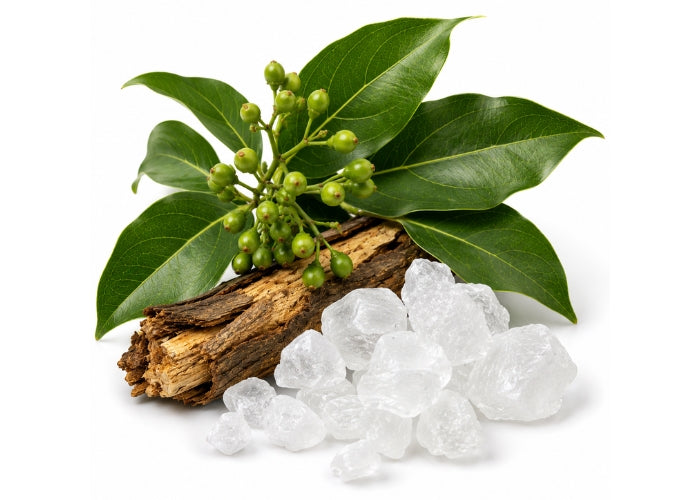
Camphor Essential Oil
Camphor Essential Oil
Camphor Essential Oil (Cinnamomum camphora)
Camphor Essential Oil is steam-distilled and rectified from the wood and branches of Cinnamomum camphora, yielding White Camphor Oil — the light, low-safrole fraction that is the only camphor grade considered suitable for topical and aromatherapy use. (Brown and Yellow Camphor are heavier fractions retained during distillation that stay high in safrole and are not used in skincare or diffusing.) It has a sharp, penetrating, camphoraceous aroma with a fresh, cineole-like edge.
Camphor has a distinctive dual action on the skin — an initial cooling sensation followed by a warming effect as it stimulates local circulation — making it a favourite in massage blends for sore muscles, stiff joints and lower back pain. It's also valued as a decongestant and expectorant, traditionally used in vapour therapy for colds, coughs, sinus congestion and bronchitis, and its anti-inflammatory properties extend to soothing minor skin irritation, insect bites and bruising. It's traditionally said to help clear mental fog and lift low energy, and is also used as a natural insect deterrent.
A little care goes a long way: Camphor Essential Oil isn't meant to be taken internally — even a small amount can be harmful, particularly for children, so keep bottles well out of reach. Always dilute well before topical use, and avoid use during pregnancy or if you have a history of seizures. Only White Camphor Oil, as supplied here, is suitable for skin or diffuser use.
Specifications
| Specification | Detail |
|---|---|
| Botanical Name | Cinnamomum camphora (White Camphor Oil) |
| Plant Part Used | Wood and Branches |
| Extraction Method | Steam Distillation & Rectification |
| Origin | China |
| Purity | 100% Pure, Natural, Undiluted |
| Appearance | Clear, Colorless to Pale Yellow Liquid |
| Specific Gravity | 0.860 to 0.910 @ 25°C |
| Refractive Index | 1.465 to 1.475 @ 20°C |
| Shelf Life | 2 Years (Properly Stored) |
Uses ▼
Burners and vaporizers
In vapor therapy, Camphor oil helps with colds, coughs, sinus congestion and bronchitis, while also clearing mental fog and lifting low energy. It can also be diffused as a natural insect deterrent.
Blended massage oil or in the bath
Well diluted, Camphor's cooling-then-warming action makes it popular for sore muscles, stiff joints, arthritic pain and lower back pain. Cold compresses with diluted Camphor oil can also help bruises and sprains.
Blended in base cream
In small amounts, Camphor oil's anti-inflammatory properties help with minor skin irritation, insect bites and bruising.
Blends Well With
| Although most essential oils blend well, Camphor oil goes particularly well with other essential oils such as basil, cajuput, chamomile and lavender. |
Usage & Formulation Guide ▼
For soap makers, natural perfumers and cosmetic formulators. These are starting points, not finished formulas — always confirm compliance, stability and safety (including IFRA usage limits) for your own finished product before use.
Aromatic & Diffuser Blends
White Camphor reads as a sharp, cooling, medicinal note rather than a classic fine-fragrance material — it sits in functional "vapour-rub" and fresh/herbal aromatic work more than in traditional perfumery. In a diffuser, a starting ratio of around 3 parts Camphor White Oil to 2 parts Eucalyptus and 1 part Peppermint gives a clean, penetrating cold-season blend, and used sparingly it can also sharpen herbal or camphoraceous fragrance accords.
Topical Muscle & Joint Rub (external use only)
For massage oils and rub-style blends, White Camphor is typically diluted to around 2-3% in a carrier oil (often paired with Rosemary) to make use of its classic cooling-then-warming action on sore muscles, stiff joints and lower back pain. This is for topical application only — always dilute well, patch test first, and never apply to broken or irritated skin.
Vapour/Chest Rub Blend
A traditional decongestant chest rub can be built around roughly 5 drops Camphor White Oil, 3 drops Eucalyptus Radiata and 2 drops Tea Tree per tablespoon of melted carrier such as coconut oil, massaged onto the chest and throat externally. As with all Camphor preparations, this is for external application only and must never be swallowed.
Soap & Cosmetic Formulation
In cold-process soap and other leave-on or rinse-off cosmetic bases, White Camphor is generally used at around 0.5-1% of total oils. Camphor is a restricted material under the IFRA Standards and is also subject to EU cosmetic regulation limits on the natural (racemic) form, so treat this figure as a conservative starting point and check the current IFRA Standard and applicable regional cosmetic regulation for your product category before finalising a formulation.

Product Documents SPECIFICATIONSSAFETY DATA SHEETIFRA GUIDELINESUSER GUIDE |
Couldn't load pickup availability
Camphor Essential Oil (Cinnamomum camphora)
Camphor Essential Oil is steam-distilled and rectified from the wood and branches of Cinnamomum camphora, yielding White Camphor Oil — the light, low-safrole fraction that is the only camphor grade considered suitable for topical and aromatherapy use. (Brown and Yellow Camphor are heavier fractions retained during distillation that stay high in safrole and are not used in skincare or diffusing.) It has a sharp, penetrating, camphoraceous aroma with a fresh, cineole-like edge.
Camphor has a distinctive dual action on the skin — an initial cooling sensation followed by a warming effect as it stimulates local circulation — making it a favourite in massage blends for sore muscles, stiff joints and lower back pain. It's also valued as a decongestant and expectorant, traditionally used in vapour therapy for colds, coughs, sinus congestion and bronchitis, and its anti-inflammatory properties extend to soothing minor skin irritation, insect bites and bruising. It's traditionally said to help clear mental fog and lift low energy, and is also used as a natural insect deterrent.
A little care goes a long way: Camphor Essential Oil isn't meant to be taken internally — even a small amount can be harmful, particularly for children, so keep bottles well out of reach. Always dilute well before topical use, and avoid use during pregnancy or if you have a history of seizures. Only White Camphor Oil, as supplied here, is suitable for skin or diffuser use.
Specifications
| Specification | Detail |
|---|---|
| Botanical Name | Cinnamomum camphora (White Camphor Oil) |
| Plant Part Used | Wood and Branches |
| Extraction Method | Steam Distillation & Rectification |
| Origin | China |
| Purity | 100% Pure, Natural, Undiluted |
| Appearance | Clear, Colorless to Pale Yellow Liquid |
| Specific Gravity | 0.860 to 0.910 @ 25°C |
| Refractive Index | 1.465 to 1.475 @ 20°C |
| Shelf Life | 2 Years (Properly Stored) |
Uses ▼
Burners and vaporizers
In vapor therapy, Camphor oil helps with colds, coughs, sinus congestion and bronchitis, while also clearing mental fog and lifting low energy. It can also be diffused as a natural insect deterrent.
Blended massage oil or in the bath
Well diluted, Camphor's cooling-then-warming action makes it popular for sore muscles, stiff joints, arthritic pain and lower back pain. Cold compresses with diluted Camphor oil can also help bruises and sprains.
Blended in base cream
In small amounts, Camphor oil's anti-inflammatory properties help with minor skin irritation, insect bites and bruising.
Blends Well With
| Although most essential oils blend well, Camphor oil goes particularly well with other essential oils such as basil, cajuput, chamomile and lavender. |
Usage & Formulation Guide ▼
For soap makers, natural perfumers and cosmetic formulators. These are starting points, not finished formulas — always confirm compliance, stability and safety (including IFRA usage limits) for your own finished product before use.
Aromatic & Diffuser Blends
White Camphor reads as a sharp, cooling, medicinal note rather than a classic fine-fragrance material — it sits in functional "vapour-rub" and fresh/herbal aromatic work more than in traditional perfumery. In a diffuser, a starting ratio of around 3 parts Camphor White Oil to 2 parts Eucalyptus and 1 part Peppermint gives a clean, penetrating cold-season blend, and used sparingly it can also sharpen herbal or camphoraceous fragrance accords.
Topical Muscle & Joint Rub (external use only)
For massage oils and rub-style blends, White Camphor is typically diluted to around 2-3% in a carrier oil (often paired with Rosemary) to make use of its classic cooling-then-warming action on sore muscles, stiff joints and lower back pain. This is for topical application only — always dilute well, patch test first, and never apply to broken or irritated skin.
Vapour/Chest Rub Blend
A traditional decongestant chest rub can be built around roughly 5 drops Camphor White Oil, 3 drops Eucalyptus Radiata and 2 drops Tea Tree per tablespoon of melted carrier such as coconut oil, massaged onto the chest and throat externally. As with all Camphor preparations, this is for external application only and must never be swallowed.
Soap & Cosmetic Formulation
In cold-process soap and other leave-on or rinse-off cosmetic bases, White Camphor is generally used at around 0.5-1% of total oils. Camphor is a restricted material under the IFRA Standards and is also subject to EU cosmetic regulation limits on the natural (racemic) form, so treat this figure as a conservative starting point and check the current IFRA Standard and applicable regional cosmetic regulation for your product category before finalising a formulation.
|
Product Documents SPECIFICATIONSSAFETY DATA SHEETIFRA GUIDELINESUSER GUIDE |